Friday, July 07, 2006

The Iron Code

I've been re-reading my Druss the Legend books this week, somehow I'm missing Legend, which is the first one I read (and the first written). One of my favorite bits of prose is the Iron Code that Druss is taught by Shadak, one of his first mentors:
“Never violate a woman, nor harm a child. Do not lie, cheat or steal. These things are for lesser men. Protect the weak against the evil strong. And never allow thoughts of gain to lead you into the pursuit of evil. Never back away from an enemy. Either fight or surrender. It is not enough to say I will not be evil. Evil must be fought wherever it is found.”

The Iron Code


I love the uncompromising quality of that code, the assumption is not that all fights will be won, but that no fights will be shirked. I would be the first to say that sometimes discretion is the better part of valour, but that is something that does not fit in the simple black-and-white world of Druss.

However, author David Gemmell is not soft on Druss, he admits that the courage of a father that backs down from a fight to protect his family may well be greater than the man that allows his ego to lead him into confrontation. So the code provides a moral compass for a character that admits it is not the only way to live - in Druss' terms he would simply see one rule for himself and another for others with different needs. Seeing Gemmell handle Druss as a father figure would have been interesting, but as he is first introduced facing his death it would require an alternate timeline to work.

Hmmm ... I'll have to see whether Gemmell makes any of his other heroic figures fathers.

Wednesday, June 28, 2006

Setting and Source Material

There is a great discussion about Setting and Source Material at the anyway blog. The most interesting bit for me was:

Last summer sometime Ninja J and I spent a whole afternoon walking all the heck over Northampton. Among many other things, we talked about a beloved old game he'd GMed; particularly, we talked about how rich and alive its setting was, how detailed. His players ate it up, he said, they'd go on and on about how compelling, complete, fully realized the setting was.

Then he told me how he'd done it. He'd taken three principles - I wish I could remember them in particular, J please step in here, but they were like "nobody thinks that they themselves are evil," "the Grand Galactic Empire is procedurally conservative," and "nobody really enjoys their job" - three principles something like those, and whenever any of his players asked him about anything in the setting, he'd simply apply those principles to create the answer.


Now that is a cool tip. it basically fits the idea that Ron Edwards pushes for Setting, which is to take a leaf from the dramatic writing how-to's and determine your game's premise - i.e. the philosophical idea it is wrestling with.

The punchline is: most RPGs' setting material (along with all primary source fiction, like Firefly or The Lord of the Rings) is the end product of a creative process. What do we roleplayers need? We need the starting point of the creative process instead.


Later in the comments Ninja J steps in to clarify his rules, and adds:

It's how I've run games ever since. Characters have motivations and anytime the protags do something, I ask myself what the NPCs would do in this situation, given their resources. Sometimes it's simple: "Queen Elizabeth's agents will never betray her because she's got something on them." "Jean-Renard is a coward and will funnel his resources into violence only as long as it will keep him out of danger." Along those lines.

I've found that you wind up with NPCs that seem really real because they're not prescripted. You have a world that seems real because, even when you don't know what's under every rock, you know the kind of thing that should be there.


Sydney summarizes with:

I'm really wondering now if the Technique we're trying to isolate from various specific instances actually involves combining

(1) seed crystals: highly specific, concrete, vividly visual images -- but with plenty of complexity and ambiguity to stimulate and allow growth in multiple directions [Angus: Characters, Ideas, Gadgets, Locations, Organisations]
(2) generation rules: simple, clear, abstract principles that guide how new specifics are derived from existing specifics.


This gives me some things to think about, I'm not sure what these should be for my own game, but I'm sure thinking about them will be more fruitful than working out yet another set of NPCs (and maps, and plot points, and ... etc) that my players never go anywhere near!
Viking Battle at Whitby Abbey

A reenactment of a skirmish between Anglo-Saxon and Viking forces circa 1066, reenacted by warriors of Regia Anglorum.

Tuesday, June 27, 2006

The 13th Warrior

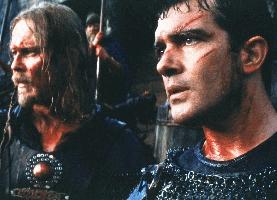
Check out some more viking goodness from 13th Warrior.

Saturday, June 24, 2006

Roleplaying Theory - GNS

I've been doing quite a lot of web-surfing recently looking at Vikings, as background for my upcoming Iron Heroes game, and a theory about roleplaying called GNS.

Along the way I found a problem with my game prep for Iron Heroes, and the possible solution in Ron Edwards' GNS. For an easy introduction to GNS, try Ben Lehman's post "An Introduction to Forge Theory #7". If GNS is new to you, you might want to go read that now, because I'm going to assume you've read it. I'll link to the full theory at the bottom of this post, but don't jump straight there, Ben's summary is enough for starters.

My basic problem is that I was brought up on the increasingly Simulationist RPGs of the 80s and 90s, I even wandered the halls of the odd Narrativist game. I thought that clearly all the troubles we had in our gaming groups could be solved by adopting game systems that more closely simulated the genre we were interested in, so as to avoid game-breaking, powergaming and wimpish play.

At the same time, I felt that I was the only person who could be trusted to run such a game (since my good friend Shan had moved to Melbourne), which meant assuming the burden of both generating comprehensive Simulationist background, and hacking rules to get a better fit to my ideal system (my personal Mission Impossible). In a comment on Ben's blog I put it this way:
My personal preference is Sim, and that explains why I can find it hard to enjoy running a heavy Gamism game, because the way I run it (Gamist) and the way I prep for it (Sim) are in opposition. I find lots of what I prepare doesn't get used, and I rarely want to return to prep for the next session - yet the players loved playing it.
To aggravate matter, game sessions run by others always left me wanting more out of them. The solution seemed to be more preparation and more work up-front, with increasingly less payoff at the end.

I think the solution is that I need to embrace the essential appeal of Gamism, keep enough Simulationist in there to establish an enjoyable theme, and make the point of the Gamism be competition in ways that satisfy my Narrativist bent. In other words, stop layering rules on D&D that ratchet up the Sim level, and look for ways to use Gamism to keep in-game competition where it belongs.

As a concrete example, I've always enjoyed the little bit of Pendragon I've played. In hindsight that was because the game rules encouraged us to play knights that matched the mythic stories of Arthur's knights. If you wanted you could slide towards magic and paganism, or be a virtuous Christian knight, or pursue the ideal of romantic love, or be fairy-touched.

Because the Pendragon system channelled our Gamist tendencies towards building characters that better engaged in the game world, it both fostered Simulationism and created the sort of investment in premise that Narrativism seeks. It is however (IMHO) a game heavily weighted towards Gamism. Character advancement was less about combat effectiveness, and more about engagement with the game world (becoming recognised as a virtuous knight) - although that brought it's own advantages.

So why don't I just start a game of Pendragon? Partly because I am less interested in that theme than I once was, and mostly because of the heavy financial investment my gaming friends have already made in D&D (of all versions). Getting them to play some sort of d20 game is easy enough, having the selected game system poit us in the right direction is harder.

Iron Heroes has some good ideas about making combat the center of attention and making all aspects of a d20 character impact upon it, through stunts and zones. I have some ideas about linking that with some house rules to encourage the sort of play I'm interested in - but I think I need to examine that in more detail before talking about it.

I'm interested in your ideas, so feel free to comment!


As promised, here are links to the original GNS articles:

GNS and Other Matters of Role-playing Theory

Gamism: Step On Up

Narrativism: Story Now

Simulationism: The Right To Dream


Tuesday, March 21, 2006

William Shakespeare in Code

William Shakespeare's 18th Sonnet has been ported to ActionScript 2.0 by Satori Canton. It loses something in the translation, but I'm sure that it meets the original's meaning exactly (at least at a quick glance it seems to).

Saturday, March 18, 2006

RPG Class Test

Smart Paladin
81% Combativeness, 26% Sneakiness, 76% Intellect, 55% Spirituality
Valorous! Noble! Or possibly just a self-righteous jerk (but with the brains to keep you alive!)... You are a Smart Paladin!


Paladins are holy warriors. They are valorous defenders of the light. Unfortunately, most of them are so ardent in their defense they tend to meet sticky ends faster than you can say "rampaging red dragon." Many people look up to Paladins, while others just consider them stuck up, overbearing, or self-righteous.


Fortunately for you, unlike most Paladins, you're pretty smart. Which means that you're more likely to fall into the "admired" category, rather than the "obnoxious" or "dead" categories.


Much like the crusades, you manage to combine violence and religion, though unlike the crusades, you add a healthy does of intelligence. You may be a staunch defender of the faith, a valorous champion of the weak, or the stuff that jihads are made of. Which ever one you are, just be happy that you've got the smarts to back it up and make it work.


My test tracked 4 variables How you compared to other people your age and gender:
free online datingfree online dating
You scored higher than 90% on Combativeness
free online datingfree online dating
You scored higher than 34% on Sneakiness
free online datingfree online dating
You scored higher than 56% on Intellect
free online datingfree online dating
You scored higher than 63% on Spirituality
Link: The RPG Class Test written by MFlowers on Ok Cupid, home of the 32-Type Dating Test